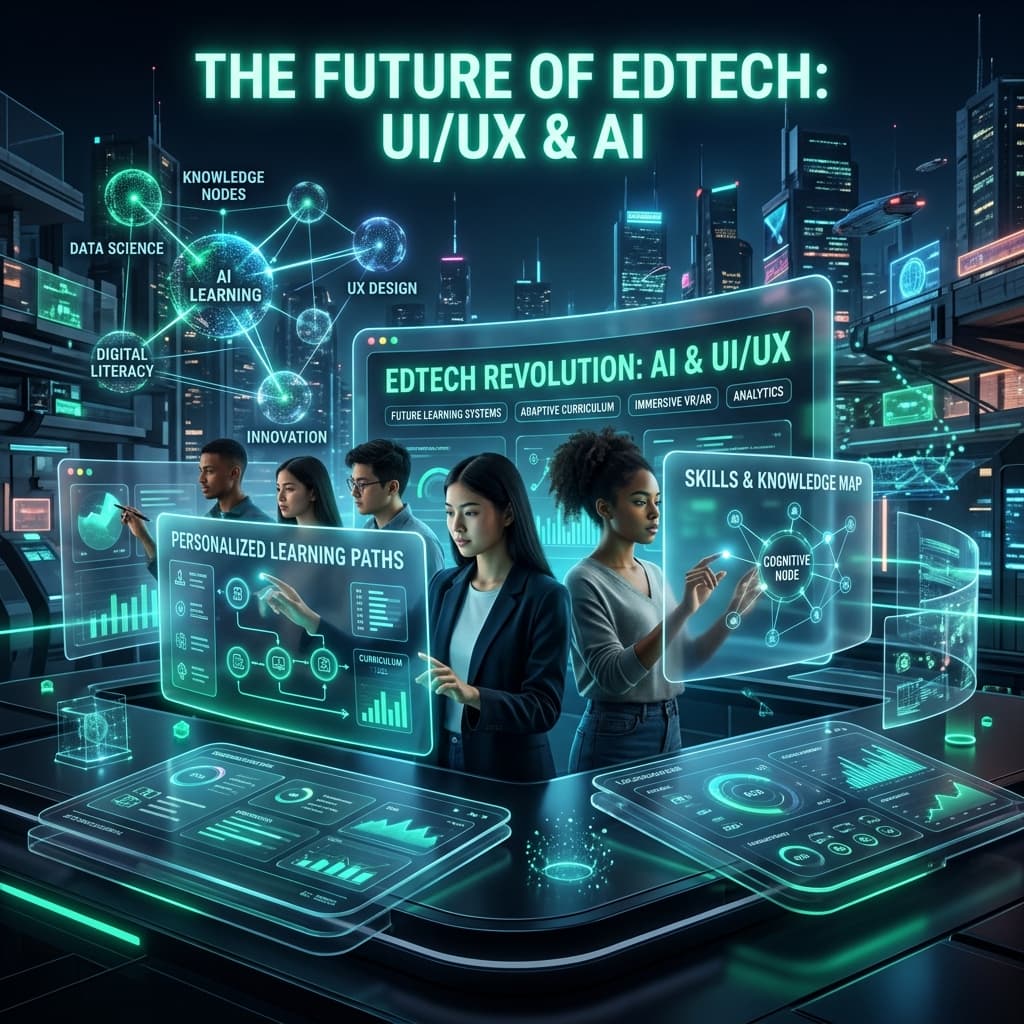
For decades, digital education was treated as a digitization problem: record a lecture, upload a PDF, add a multiple-choice quiz, and host it on an LMS. But anyone who has studied human cognition or spent hours navigating clumsy portals knows the truth: information delivery is not learning. Today's learners do not suffer from a lack of information; they suffer from cognitive fatigue and disengagement. As frontend engineers and instructional designers, our mission is to move beyond passive consumption and build interactive digital ecosystems that actively stimulate comprehension and retention.
1. Cognitive Load Theory: The North Star of UI/UX in Learning
At the core of effective educational interface design lies John Sweller’s Cognitive Load Theory (CLT). Working memory has a strictly limited capacity. When an educational application presents visual clutter, inconsistent navigation, or redundant text, it consumes extraneous cognitive load — brainpower wasted on deciphering the interface rather than mastering the subject matter.
- Intrinsic Load: The inherent difficulty of the academic topic. This cannot be eliminated, but can be broken down into progressive micro-modules.
- Extraneous Load: Mental effort wasted due to poor design, distracting popups, and confusing information architecture. Our goal in UI design is to reduce this to near zero.
- Germane Load: The productive cognitive processing dedicated to constructing mental schemas and deep understanding. UI/UX should maximize this by providing relevant visual cues and interactive models.
2. Instructional Scaffolding: Translating Vygotsky into UI Patterns
In developmental psychology, the Zone of Proximal Development (ZPD) describes the sweet spot between what a learner can do independently and what they can achieve with guidance. In modern web development, we can translate this pedagogical concept directly into UI components: progressive disclosure, contextual tooltips, dynamic step-by-step wizards, and intelligent hints that dynamically fade away as the user gains mastery.
A truly great educational UI does not act like a static textbook; it acts like an empathetic tutor that anticipates your hesitation and provides the exact scaffold needed at the exact moment of doubt.
3. The Power of Micro-Interactions and Instant Feedback Loops
One of the fundamental failures of traditional online courses is delayed feedback. A student submits an assignment or test, and receives a grade days later — long after the neural moment of curiosity has passed. In modern React and Next.js applications, we can deliver instant, deterministic feedback loops. Whether through interactive code sandboxes, visual drag-and-drop infographic builders, or gamified quiz state machines, immediate visual validation triggers dopamine and reinforces correct mental models. Subtle micro-animations (such as glowing neon borders or gentle spring physics) signal state changes without startling the user.
4. Technical Architecture: Speed as a Prerequisite for Learning
Performance in EdTech is not merely a technical benchmark; it is an accessibility and cognitive requirement. When a web page takes more than two seconds to load, or layout shifts (CLS) interrupt reading flow, the student's train of thought is instantly broken.
- Server-Side Rendering & Static Pre-rendering: Delivering pre-rendered HTML ensures that core lesson content is accessible in milliseconds even on low-bandwidth mobile devices.
- Atomic State Management: Keeping UI state lightweight and modular prevents stuttering animations when processing real-time simulations and quizzes.
- Accessible Dark Themes: High-contrast, meticulously calibrated color palettes (WCAG AAA compliant) that prevent eye strain during prolonged night study sessions.
Conclusion: Building the Future of Autonomous Learning
The intersection of Educational Technology, Cognitive Science, and High-Performance Frontend Engineering represents the next frontier of digital experiences. When we design educational platforms with empathy, mathematical rigor, and aesthetic excellence, we don't just teach facts — we empower human curiosity and shape how the world learns.